
Filter press in wastewater treatment is used for sludge dewatering. Let’s learn its working principle, types, applications, advantages, and limitations in this complete blog.
Introduction
Wastewater treatment is essential for protecting the environment and saving water. Industries like chemicals, pharmaceuticals, food processing, and textiles produce huge amounts of wastewater daily. For sludge dewatering, there is need of effective equipments. One of them is the filter press.
In this blog, you will understand the working principle, types, applications, advantages and limitations of filter press in wastewater treatment.
What is a Filter Press?
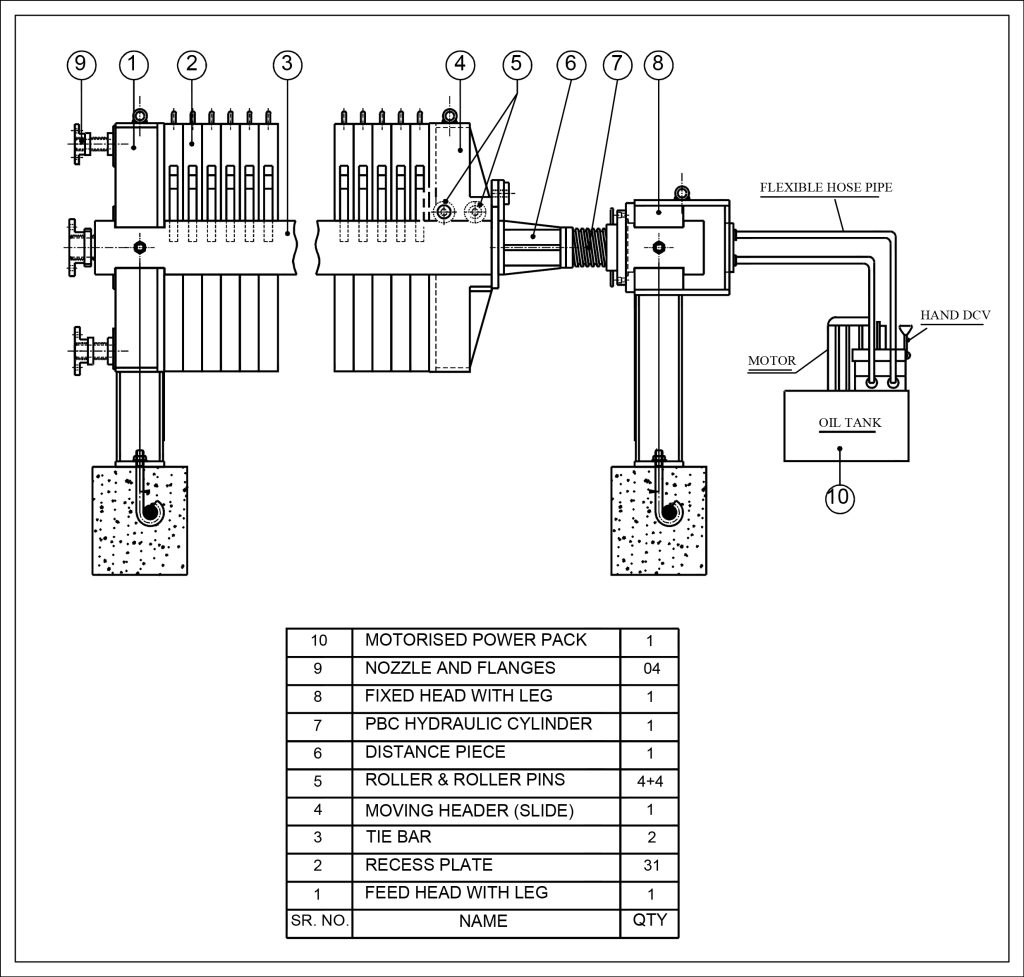
Filter Press is a mechanical device uses pressure energy to separate solids from liquids. It is broadly used in wastewater treatment plants where sludge or slurry must be dewatered. The process leaves behind filtrate (water) and a solid “filter cake” for disposal.
Working Principle of Filter Press
Filter press operation follows following four main steps :-
- Slurry Feeding – Wastewater mixed with sludge is pumped into the filter press with the help of filter feed pump.
- Filtration – Water passes through filter cloths under high pressure and solids remain.
- Formation of Cake – Solid particles (sludge) collected between plates and forms dry sludge cake.
4. Cake Discharge – Once the cycle is completed, plates opened and cakes discharged to disposal area.
Types of Filter Press
1. Plate and Frame Filter Press
- It is the oldest design, with alternating plates and frames.
- It is suited for small-scale operations.
2. Recessed Plate Filter Press
- In this type, plates have a recess to form a cavity for sludge cake storage.
- It is more efficient than plate & frame type.
3. Membrane Filter Press
- It uses flexible membranes to squeeze the sludge cake.
- It produces drier sludge cake and reduces cycle time.
4. Automatic Filter Press
- It is fully automated design which saves labour and time.
- It is ideal for large industries with high sludge volumes.
Applications of Filter Press in Wastewater Treatment
Filter presses are widely used in different industries :-
- In municipal plants for sewage sludge dewatering.
- In food & beverage industry for treatment of process wastewater.
- In pharmaceuticals & chemicals industries for handling hazardous sludge.
- In mining & metallurgy plants for separation of fine particles.
- In textile & dye industry for removal of coloured effluents.
Advantages of Filter Press
- It producesfiltrate (high-quality water).
- It reduces sludge volume and disposal cost.
- Operation and maintenance is simple.
- It is available in manual, semi-automatic, and automatic models.
- It is useful for many types of industrial wastewater.
Limitations
- It operates in batch mode and not in continuous mode.
- It requires high-pressure pumps.
- In this filter cloths need regular cleaning/replacement.
- It has high initial cost for fully automatic models.
Conclusion
The filter press is an efficient technology for sludge dewatering in wastewater treatment. It reduces sludge volume, lowers disposal costs, and provides filtrate (high-quality water). Modern filter presses are becoming more efficient and user-friendly due to automation and new materials.
Leave a Reply